
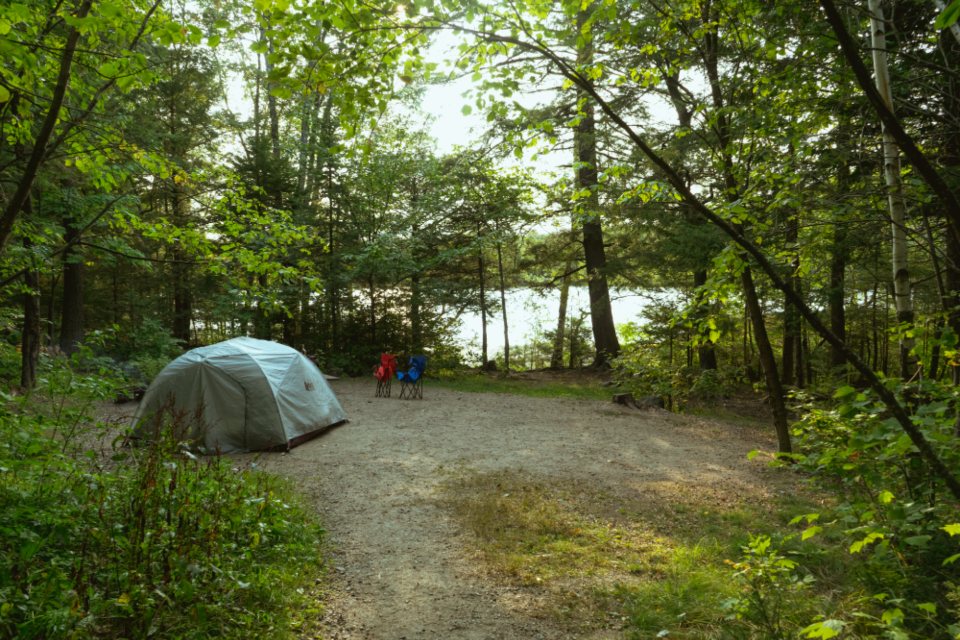
Every spring we put the tent up in the backyard before it goes anywhere near a campground. It started as a way to check the poles after a winter in the garage, but it has become the most useful night of the camping year. A backyard camp is a full rehearsal: the gear gets tested, the kids get a first night under nylon with their own bed 20 metres (65 feet) away, and every problem you find costs you a walk to the kitchen instead of a ruined weekend. Here is how we run it, and what it has caught over the years.
Why rehearse at all
The first real night in a tent is a bad time to discover things. That the sleeping pad has a slow leak. That the tent you bought online has a broken zip. That your four-year-old is fine until it gets properly dark and then very much is not. That you forgot a mallet, a lighter, a can opener, or a way to hang the lantern. On a real trip, any one of those becomes the story of the weekend. In the backyard, it becomes a two-minute fix and a note for the packing list.
There is also a confidence angle, for children and for nervous adults. A kid who has slept in the tent once, even 10 metres (33 feet) from the back door, walks into the real campground as a veteran. A parent who has already figured out the stove in daylight is a parent who is not swearing at it at 7 p.m. in the rain.
Do it properly: real rules, real gear
The rehearsal only works if you treat it like a trip. The rules we hold ourselves to:
- Pack the car, or at least the bins, exactly as you would for the real trip, then unpack them in the garden
- Nobody goes inside the house after dinner except for the toilet, and only if you would have a toilet at the campground
- Cook dinner and breakfast on the camp stove or fire pit, using the camp pots and the camp water containers
- Phones charge from the power bank, not the wall
- Sleep in the sleeping bags on the pads, with the bedtime routine you plan to use at the campground
- Take the tent down and pack it the next morning, and time it
Keep a notebook by the tent door. Every time someone says “we should have brought” or “this does not work,” write it down. That list becomes your real packing list and it is worth more than any generic one you will find.
Test the tent like you mean it
Put it up once with the instructions, then take it down and put it up again without them. Note how long the second attempt takes with everyone helping. Check every zip, every pole section and every guyline. Peg out the fly fully, tension it, and then, if you have a hose, spray the tent for a few minutes from above and from the side. A tent that leaks along a seam in the backyard is a tent you can re-seal with seam sealer before the trip. A tent that leaks at a campground is a wet sleeping bag.
Lie down inside with everyone who will be sleeping in it, with the pads and bags laid out, and with the bags of clothes you plan to keep inside. If it feels tight in the garden, it will feel impossible after two days of rain. This is the moment to decide whether you need a bigger tent or a second one.
Test the sleep system, because sleep is everything
Most bad camping trips are really bad sleep. The backyard tells you what the real night will feel like before it matters. Inflate the pads a couple of hours before bed and check them again at bedtime; a pad that has lost pressure has a leak, and a leak found now is a patch job at the kitchen table. Try the sleeping bags with the layers you would actually wear. If a child is cold at 12 degrees C (54 F) in the garden, they will be cold at a campground where nights can drop several degrees lower.
Pay attention to the small things: is the pillow situation workable, does the child’s bag zip from the inside, does the headlamp have fresh batteries, and where does everyone put their glasses and phone at night. A tent with no pockets and no gear loft becomes a nest of lost objects. A cheap hanging organiser fixes it.
Watch the kids, and adjust
The backyard is where you learn what your child actually needs to sleep outdoors. Some kids are asleep in ten minutes and the rehearsal tells you nothing except that they are ready. Others need a nightlight, a specific toy, the door unzipped slightly, or a parent in the tent until they drop off. Better to learn that with the house right there. If a child has a full meltdown and ends up in their own bed at 11 p.m., that is not a failure. It is data. Try again in two weeks, maybe with a friend or sibling in the tent, and see if it changes.
Run the morning too. Kids wake early in a tent because the light comes in at dawn, which in midsummer can mean 5 a.m. Decide how you will handle it: a quiet activity box in the tent, an eye mask for the adults, or an early breakfast and a walk. Whatever you settle on, you will be glad you settled it in the garden.
The morning after: fix, replace, repack
The rehearsal is only worth something if you act on it. The morning after, go through the notebook. Re-seal the seam. Order the missing tent pegs. Add the can opener and the mallet to the box, and leave them there permanently. Replace the headlamp batteries. Put the things you never touched back in the garage; a rehearsal is as good at finding what you do not need as what you do.
Then repack the bins in the order you will unpack them at the campground: tent and bedding first, kitchen second, clothes and everything else after. Label them. Weigh them if the car is small. Our kitchen bin came in at 14 kg (31 lb) the first time and we cut it to 9 kg (20 lb) once we saw what had stayed in the box all night.
A backyard camp will never feel like the real thing, and it is not supposed to. Nobody is going to tell stories about the night they slept 15 metres (50 feet) from their own fridge. But the trip it makes possible, the one where the tent went up in twelve minutes, the pads held air and the kids fell asleep by 9, is a story everyone will tell for years.