
The campground changes character once the fire burns down. Sounds carry further, the sky opens up, and kids who were bored an hour earlier are suddenly wide awake with a flashlight in each hand. Most families treat that hour as the wind-down before bed, and fair enough. But some of our best camping evenings started at full dark: lying on a tarp counting satellites, following a trail of glow sticks through the trees, or walking a familiar path with all the lights off to hear what the forest does at night. None of it needs special equipment beyond a headlamp with a red setting and a bag of glow sticks. What it needs is a bit of planning in daylight, a clear set of boundaries, and the patience to let everyone’s eyes adjust. Here is how we run night games so they stay magical instead of chaotic.
Getting eyes and expectations ready
Human eyes take about twenty to thirty minutes to adapt fully to darkness, and one glance at a white flashlight or a phone screen resets a good part of that. So the first rule of every night activity is light discipline: red headlamps only, phones in pockets, and the campfire either out or behind a screen of trees. Explain this to the kids as a challenge rather than a rule and they police it better than adults do. The second is timing. In June and early July at northern latitudes the sky is not properly dark until well after 10 p.m.; by late August it is dark by around 9, which is why late summer is the sweet spot for family stargazing. Check the moon phase too: a full moon washes out all but the brightest stars, while the week around new moon gives the darkest skies.
Stargazing challenges that keep kids looking up
Lying on your back on a tarp is the entire technique. From there we run a series of small challenges rather than a lecture. First, find the Big Dipper and follow the two stars at the end of its bowl to Polaris, the North Star; whoever finds it first gets to name the next target. Then count satellites: on a clear summer night you can usually spot several in an hour, small steady points of light crossing the sky, and the International Space Station is often bright enough to be unmistakable when it passes. Then the meteor count, which is best in the second week of August, when the Perseid shower peaks around the 12th and 13th with rates that can reach dozens per hour after midnight from a dark site.
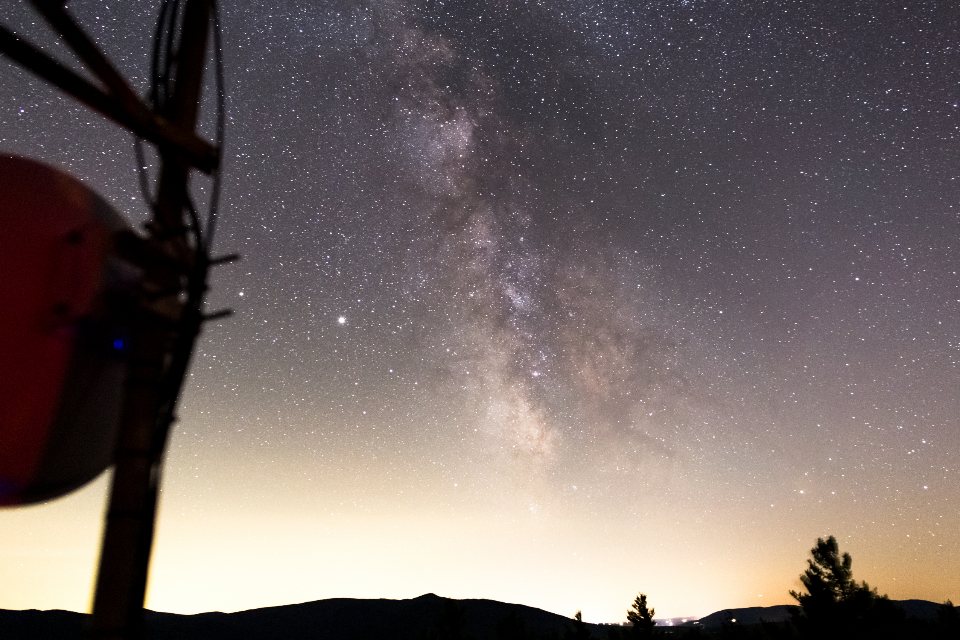
For longer attention spans, try the Milky Way test: from a dark campground in July or August, the band of our galaxy runs roughly overhead, and the darker the site, the more texture you can see in it. A simple challenge is “find the darkest patch of sky,” which teaches kids to notice light pollution from the nearest town on the horizon. Bring a star chart on paper, since a phone screen defeats the purpose.
Glow trails: a night walk kids will beg to repeat
A glow trail is exactly what it sounds like. In daylight, walk a short loop, 200 to 400 metres (a quarter of a mile or so), on a path with no drop-offs or trip hazards, and note landmarks. After dark, one adult goes ahead and hangs glow sticks at child height every 10 to 15 metres (30 to 50 feet), on branches or stakes, with a different colour marking each turn. The kids then follow the trail in the dark with no lights, collecting the sticks as they go. Variations: hide a “treasure” glow stick off the trail within sight, add a riddle at each colour change, or run it as a relay where teams start from opposite ends.
- Use the loop trail nearest your site so the finish is your own picnic table.
- Count the sticks out and count them back in; a glow stick left in the forest is litter.
- Keep the trail away from water, roads and other occupied sites.
- One adult at the front, one at the back, and a whistle each for the youngest children.
Night hikes: the same trail, a different forest
A night hike is not about distance. We pick a trail we walked that day, no more than a kilometre (about half a mile) each way, wide and flat, and set off with headlamps on red. The point is to stop often and listen. Owls call from spring through autumn, frogs are loudest in the early summer, and on a still night you can hear a beaver slap its tail from a long way off. Halfway along, everyone turns their lights off for a full two minutes of silence. It sounds like a long time to a seven-year-old; it is also the part they talk about the next day. On the way back, a small challenge: spot the reflected eyeshine of a moth or a spider on the trail edge with a light held at eye level, a trick that works because the reflection bounces straight back to you.
Safety on a night hike is mostly common sense, but it is worth stating. Everybody carries a light even if it stays off, and a spare set of batteries is with an adult. Nobody runs. Long trousers and closed shoes protect against roots and ticks. Tell someone at the site where you are going and when you will be back, and keep it under an hour.
Quiet games for the last half hour
Once the walking is done and the fire is a bed of coals, a few games fit the mood without breaking quiet hours. Shadow puppets against a tent wall with one headlamp behind it. “Sound bingo,” where each person listens for a set of night sounds and calls them as they come: wind in the pines, a loon, a car on the far road, a zipper three sites over. Story rounds, where each person adds one sentence to a tale about the thing that lives in the outhouse. These are the games where the youngest fall asleep on someone’s lap, which is the sign of a good night.
Being a good neighbour after dark
Most campgrounds enforce quiet hours from around 10 or 11 p.m., and night games have to respect that. The glow trail and the night hike are silent activities by design; stargazing is whispers. Keep lights pointed down, stay within your loop, and gather every glow stick before bed. Done right, nobody else knows you were out, and your kids have a sky full of stars they found themselves.