
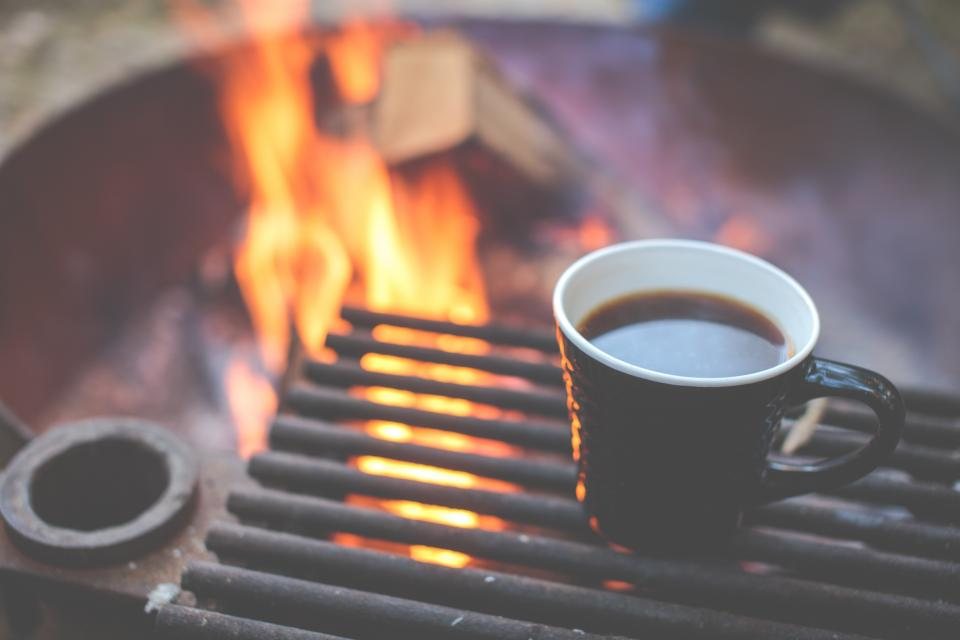
Breakfast is the meal that sets the mood for a camping day, and it is also the one most likely to go wrong, because everyone wakes up at a different time, the fire is out, and nobody has had coffee yet. Over many mornings we have settled on a simple system: coffee first, using whichever method suits the morning, then a single pan that feeds the whole crew with almost no washing-up. Neither part needs special skill. What they need is a bit of order, a kettle that goes on before anything else, and the acceptance that a camp breakfast is at its best when it is generous rather than fancy.
Water first, and how much of it
Whatever else happens, the first job of the morning is to put water on. A two-litre (half-gallon) kettle covers coffee for four plus a little for washing, and a wide, thin-bottomed kettle boils faster than a tall narrow one. On a gas stove that is about six to eight minutes; over coals from last night’s fire, rekindled with a handful of kindling, it is closer to fifteen, which is why we run a small stove alongside the fire even on trips where we cook mostly on wood. While the water heats, someone lays out mugs, milk and sugar, and someone else starts the fire or the second burner for the pan. That small division of labour is the difference between a calm morning and a hungry one.
Four ways to make coffee outdoors
Cowboy coffee is the oldest and needs nothing but a pot. Bring water to a boil, pull it off the heat, stir in one heaped tablespoon of coarse ground coffee per cup, wait four minutes, then sprinkle a splash of cold water over the top to settle the grounds and pour slowly. It is rougher than it sounds and surprisingly good, especially with a pinch of salt in the grounds.
A press pot is the crowd favourite for families. Use the same coarse grind and ratio, about 15 grams of coffee for every 250 ml (one cup) of water just off the boil, stir once, wait four minutes, press gently and pour it all out immediately so it does not keep stewing.
Pour-over is the lightest and cleanest: a folding cone or a plastic dripper, a paper filter, medium ground coffee and a slow, circling pour. It makes one or two cups at a time, so it suits early risers who want something before the crowd is up.
A stovetop moka pot makes a small, strong brew that is closest to espresso. Fill the base with hot water to just below the valve, fill the basket loosely with fine ground coffee, and set it on a low flame with the lid open until it gurgles. Take it off before it sputters, or it will taste burnt. It is heavy, but for two people who take coffee seriously it is worth its place in the box. Whichever method you pick, grind at home the night before departure; whole beans keep better, but a hand grinder at six in the morning tests everyone’s patience.
The one-pan method
The one-pan breakfast is not a recipe so much as a sequence. Everything that takes longest goes in first, and each new ingredient is pushed to the side or stirred in as the previous one is nearly done. A 30 cm (12 in) cast iron or carbon steel skillet is ideal because it holds heat, tolerates coals and can go straight to the table. Start over medium heat with fat: bacon, sausage or a spoon of oil. Once the meat is browned, move it to the edge of the pan and add the slow vegetables, diced potato or sweet potato, and let them fry undisturbed for five minutes before turning them. Then come the quick vegetables, onions, peppers, spinach, cherry tomatoes, for another three or four minutes. Finally make wells in the mixture and crack in the eggs, cover the pan with a lid or a sheet of foil, and let the steam set the whites for four minutes. Cheese on top, salt and pepper, and the pan goes down in the middle of the table with a stack of forks.
A few shortcuts make this even easier. Boil and dice the potatoes at home, so they only need browning. Pre-cook the sausage or bacon at home too, and bring it chilled; it reheats in the pan in two minutes. Crack eggs into a screw-top jar before leaving and pour them straight in, which avoids broken shells in the cooler. For a sweet version, run the same sequence with butter, sliced apples and cinnamon, then pour a thin pancake batter over everything and cook it under a lid until set.
Heat management for a pan on a fire
A skillet on coals behaves differently from one on a stove. The heat is uneven and it fades, so keep the pan on a grate rather than directly in the embers, and keep a small feeder fire going to top up. If the pan is scorching, lift it onto two rocks at the edge of the ring for a minute rather than pulling it off altogether; if it is too slow, rake fresh coals underneath. Long tongs and a heavy glove are non-negotiable. On a two-burner gas stove the problem is the opposite: the flame is small and central, so the middle of a big pan burns while the edges stay cool. Move food around often, and use a heat diffuser or a second smaller pan if you are feeding more than four.
Clean-up before the day starts
The beauty of the one-pan method is that clean-up is one pan and a kettle. Scrape the skillet with a wooden spatula while it is warm, add a splash of the leftover hot water, brush it clean and dry it on the heat for a minute before wiping with a drop of oil. Never leave a greasy pan out: it attracts insects, raccoons and, in some areas, bears, and it will smell for the rest of the trip. Rinse the coffee pot with boiling water rather than soap so the next morning’s brew is not flavoured with detergent, and stow all food and rubbish back in the car or the locker before anyone wanders off.
A sample morning, timed
To show how it fits together: at 7:00 the kettle goes on the stove and one adult lights kindling on last night’s coals. At 7:08 the water boils, coffee goes into the press, and the skillet goes on the grate with the bacon. At 7:12 coffee is poured and the potatoes go in. At 7:20 the vegetables go in, followed by the eggs at 7:24. At 7:30 the pan is on the table, the children are awake because they smelled it, and the whole thing has taken half an hour, including the first two cups of coffee. Nothing about it is difficult, and it turns the slowest part of a camping day into the part everyone looks forward to.