
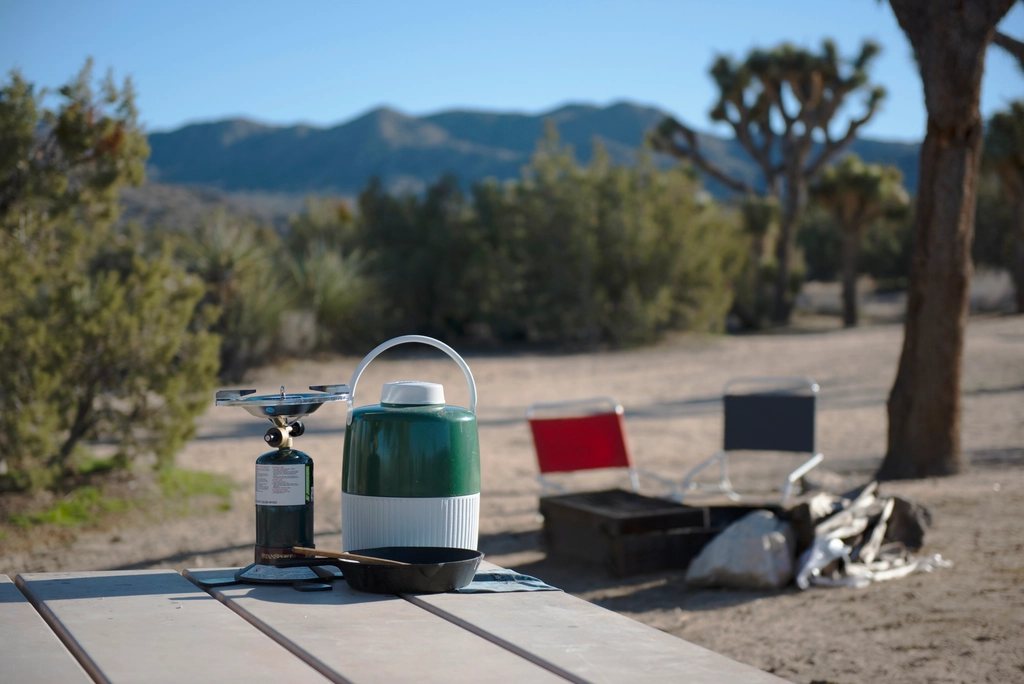
For years our camp kitchen was a single picnic table covered in everything: the stove at one end, a cutting board balanced on a cooler lid, plates stacked on top of the food bin, and somebody’s coffee cup in the middle of it all. Meals took forever and something always ended up on the ground. Then we started setting up two tables with distinct jobs, and cooking at the campground became something we look forward to rather than a chore to get through.
The idea in one sentence
One table is for heat, and one table is for everything else. The stove table holds the burners, the fuel, the pots that are on the fire and the tools you use while cooking. The prep and service table holds the cutting board, the food, the plates and the wash-up. Keeping the two separate means nobody chops next to a flame, the stove never gets buried under bags of bread, and two people can work at once without bumping elbows.
The stove table
The stove table should be sturdy, heat-tolerant and at a comfortable working height, around 75 to 80 cm (30 to 32 in) for most adults. A folding aluminium table with a slatted or solid metal top works well. If you only have a plastic-topped table, put a thin sheet of plywood or a metal baking tray under the stove; a two-burner stove at full blast can soften a plastic surface.
On it goes the two-burner stove, set level and with the windscreen facing the breeze. Beside the stove, and never behind it where you would have to reach across the flame, sit the tools: a long spatula, tongs, a wooden spoon and a pot lifter in a cup or hung from a hook on the table edge. A small towel for hot handles hangs on the same hook. Fuel canisters or the propane bottle sit on the ground beside the table legs, connected but out of the way of feet.
The stove table also has one empty zone, about the size of a large pot, where anything hot lands when it comes off the burner. Nothing else lives in that zone. A trivet or a folded towel marks it, and it stops the mad search for a place to put a boiling pot of pasta.
The prep and service table
The second table is the busy one. At the end nearest the stove, a large cutting board and a knife in a sheath. Beside it, the day’s ingredients in a single bin or basket, pulled from the cooler just before cooking so the cooler lid stays shut. In the middle, the plates, bowls, cups and cutlery in a crate that goes straight back into the car after the meal. At the far end, the wash-up station: two collapsible basins, one for soapy water and one for rinsing, a scrubber and a small bottle of biodegradable soap.
A picnic table, if the site has one, makes an excellent prep table because it is big, heavy and already there. We cover the end we cook on with a wipe-clean oilcloth so we are not chopping on decades of other people’s ketchup. Then the family eats at the other end while the cook finishes up. If there is no picnic table, a second folding table 120 cm (4 ft) long is plenty.
Where the cooler lives
The cooler is not a table. Every time it becomes a surface, the lid stays open while somebody finishes what they were doing on top of it, and the ice melts. It lives on the ground in the shade, on the far side of the prep table from the stove, with the lid latched and a bin of dry goods stacked on top to discourage anyone from opening it casually. We pack it with drinks at one end and food at the other, so the ten-times-a-day drink run does not expose the meat.
Dry food, spices and the bread live in a lidded plastic bin under the prep table. A second bin holds the pots, pans and the kettle. When the kitchen is set up, both bins slide out and open; when it is packed down at night, everything goes back into them and into the car, which is both the tidy thing and the wildlife-safe thing to do.
Flow, light and shelter
Set the two tables in an L shape, with the stove table on the short leg and the prep table on the long one, so the cook can turn from board to burner without walking. The open side of the L faces the eating area; the closed corner faces the wind, or the tarp pole, or the car. A headlamp is fine for a solo cook, but a lantern hung from the tarp ridge line above the corner of the L lights both surfaces at once for evening meals.
The whole kitchen fits under a 3 by 3 m (10 by 10 ft) tarp with room to spare, which means we cook in the rain without anyone getting wet or the stove blowing out. Pitch the tarp high enough at the stove end that the heat and steam clear it, and keep the flame at least a metre from the fabric.
The packing list that makes it work
The two-table system does not need much gear, but each item has a home:
- Two folding tables, or one folding table plus the site’s picnic table.
- A two-burner stove with a windscreen, fuel, and a lighter kept in the stove tool cup.
- One bin for pots, pans, kettle and stove tools; one bin for dry food and spices.
- A crate of plates, bowls, cups and cutlery for the whole group, plus two extra of everything.
- Two collapsible basins, biodegradable soap, a scrubber and two tea towels.
- A large cutting board, one good knife in a sheath, and an oilcloth for the picnic table.
- A lantern with a hook, and a small trash bag holder that clips to the prep table.
Set up in this order the first evening: tarp, stove table, prep table, bins out and open, cooler in the shade. Take it down in reverse before bed. The first time takes twenty minutes. By the third trip it takes ten, the kids know where the plates are, and dinner at the campground stops feeling like an expedition.