
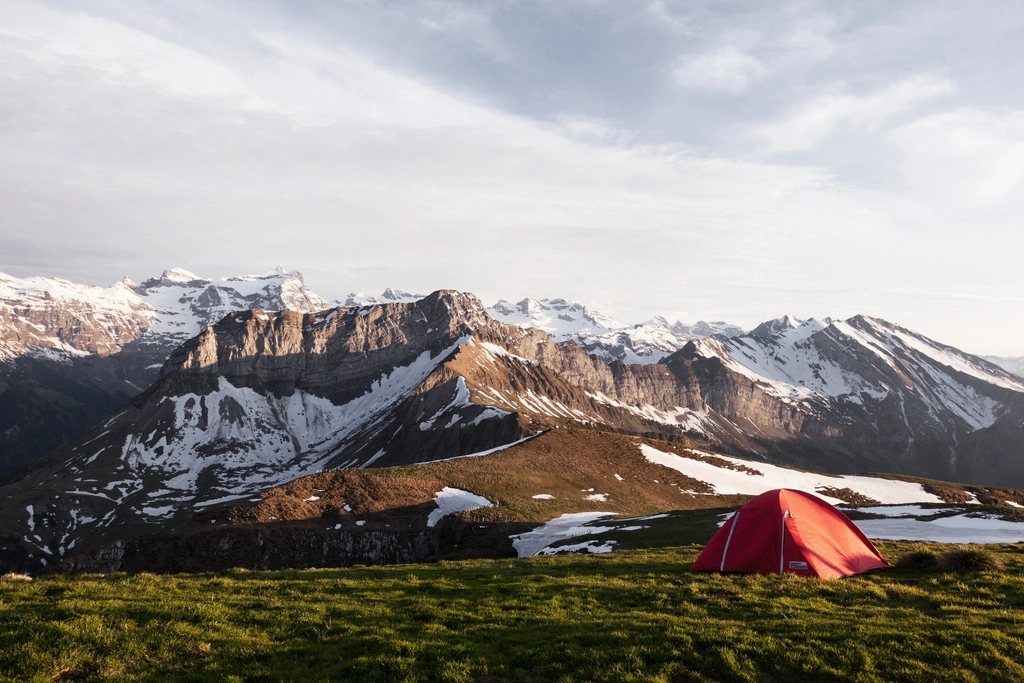
Most of our tent disasters happened on trips that started in sunshine. The forecast said a chance of showers, we pitched wherever the ground looked flattest, and at two in the morning we were outside in underwear chasing a fly sheet across the field. Bad weather is not really the problem; a tent pitched for good weather is. Here is how we set up now, every time, so that a squall at midnight is a noise rather than an emergency.
Read the site before you unpack anything
The first ten minutes at a campsite decide the whole night. Walk the pitch with the weather in mind. Where does the wind come from, and what will block it? A line of trees, a rock outcrop or even a parked vehicle takes a lot of energy out of a gust, and the sheltered zone extends roughly five to eight times the height of the obstacle downwind. A tent pitched twenty metres behind a stand of ten-metre spruce is in a different climate from one pitched in the open.
Then look at the ground. Water runs downhill, which is obvious until you are lying in it. Avoid the low spot in the middle of the pitch, avoid dips at the base of a slope, and avoid the pretty flat spot by the stream that will be underwater if the stream rises 30 cm (1 ft) overnight. A slight rise or a gentle slope that drains away from the tent is ideal. Look for old water channels, flattened grass and silt lines: they tell you where the last storm went.
Finally, look up. Dead branches, called widowmakers for a reason, come down in wind. Move well away from any large dead limb, and think twice about pitching directly under any single tall tree in a thunderstorm.
Orientation: point the small end at the wind
Every tent has a strong axis. Tunnel and dome tents shed wind best when the narrow end or the lowest corner faces into it, so the gusts slide over the top rather than hitting a wall flat on. Cabin tents have no good side, which is why we leave ours at home when wind is forecast. Put the door on the sheltered side so that opening it does not fill the tent with rain, and so the vestibule stays usable.
If the wind is likely to shift, and in most storms it does, we orient for the strongest expected direction rather than the current breeze. A quick look at the cloud movement and the forecast wind direction is worth more than licking a finger.
Guy lines do the real work
The pegs at the corners hold the floor in place. The guy lines hold the tent in shape, and a tent that keeps its shape sheds wind and rain; a tent that flaps loses both. Most family tents ship with far fewer guy lines attached than they have attachment points, so we add extra cord to every loop on the fly before the first trip.
Guy lines should leave the tent in line with the seam they are supporting and hit the ground at about 45 degrees, which usually means the peg is roughly as far from the tent as the attachment point is high. Peg them in at an angle leaning away from the tent, with the hook facing outward. Tension every line, and then walk around and tension them again after ten minutes, because the fabric settles and the first pull is never the last.
In soft ground, standard pegs pull out. Longer pegs, or pegs backed up with a rock or a second peg driven through the loop at a different angle, hold much better. In very hard or rocky ground, tie the lines to boulders, logs or the car’s roof rack. We carry a dozen spare pegs and 20 m (65 ft) of extra cord in the tent bag for exactly this.
Pitching in rain without soaking the inside
A tent that pitches fly-first, or inner and fly together, is a real advantage when it is already raining. If yours pitches inner-first, throw the fly loosely over the inner as soon as the poles are up, even before pegging, so that most of the rain lands on the outside. Working from under a tarp rigged over the pitch is easier still, and it is why the tarp comes out of the car before the tent does.
Keep the inner tent door shut until the fly is fully on and pegged. Everything that must go inside goes in through the vestibule, where wet jackets and boots can be stripped off first. A small folded groundsheet at the door catches the drips.
The tarp: a roof for the whole site
A 3 by 4 m (10 by 13 ft) tarp with a ridge line and six or eight guy points transforms a wet weekend. Pitched over the picnic table, it gives you a dry kitchen and dining room. Pitched as a lean-to on the windward side of the tent, it takes the force out of gusts and keeps driving rain off the fly.
A few things make a tarp work rather than flap:
- Rig the ridge line between two trees, a tree and the car, or two poles, at a height that lets you stand at the middle but not at the edges.
- Pitch it with a clear slope so water runs off one side, never as a flat roof that collects a pond.
- Put the low side toward the wind and the rain.
- Tension every corner and mid-point, and add a line to the centre of any long edge to stop it lifting.
- Leave one corner low as a drip point, and do not put the cooler under it.
The last walk before bed
Before we turn in on a windy night, one of us does a full circuit of the site with a headlamp. Every guy line gets a tug. Every peg gets a push. Anything loose on the table goes into the car. The vestibule zips close, the fly vents stay open a crack so we do not wake up in a cloud of condensation, and the flashlight sits by the door. It takes five minutes, and it has meant the difference between a story told over breakfast and a night spent in the car.