
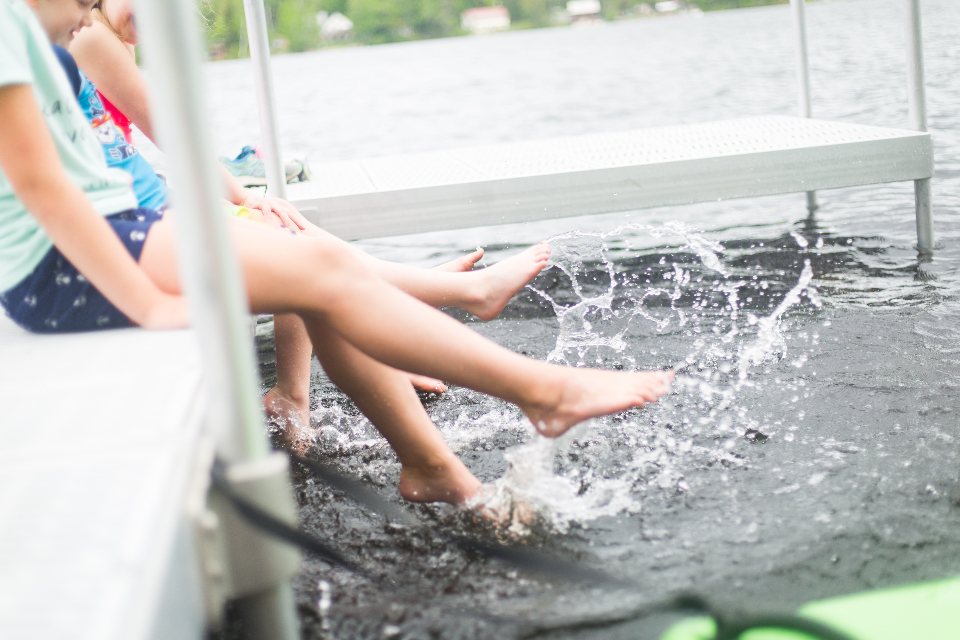
Water is the reason half of us go camping in the first place. A lake with a sandy edge or a slow bend in a river turns a hot afternoon into the best part of the trip, and the games practically invent themselves. But water is also where the rules of the campground change: a scraped knee on the lawn is a story, a slip on a wet rock above a fast channel is a phone call nobody wants to make. So this article is in two halves. The first is the games we come back to at the lake, all of which need little more than a ball, a few floating toys and a marked swimming area. The second is the set of river habits we apply without discussion, every time, because rivers behave very differently from lakes and most of the risks are invisible from the bank.
Reading the swimming spot before anyone gets wet
We do the same walk at every new beach. Where is the drop-off, and can we see the bottom to that point? Is there a marked swim area with buoys, and is the far buoy line a realistic distance for the weakest swimmer? Are there boat lanes, docks or launch ramps nearby? What is the water temperature? Even in July, lakes in the north can be around 18 to 20 C (64 to 68 F) at the surface and much colder a metre down, and water below about 15 C (59 F) can trigger cold shock, an involuntary gasp that is dangerous if your face is under. Ten minutes of looking sets the boundary for the games that follow, and the boundary is the first rule we explain to the kids.
Two more non-negotiables: an adult is designated as the watcher, with no book and no phone, in shifts of about twenty minutes, and non-swimmers and weak swimmers wear a properly fitted life jacket in the water, not a foam toy. Inflatable arm bands are toys, not flotation devices.
Shallow-water games for mixed ages
The best shallow games work where the water is between knee and waist deep on the smallest player. Sharks and minnows is the classic: one “shark” stands in the middle, the “minnows” line up on one side and try to cross to the other without being tagged; tagged minnows become sharks. Keep the crossing zone to about ten metres (thirty feet) so the small ones can make it. Marco Polo is the other standard, but we only play it where the water is shallow enough that the person with closed eyes can stand.
Beyond tag games, a floating ball opens up water volleyball over an imaginary line, keep-away in a circle, and our family favourite: the bucket relay, where teams carry water in cupped hands from the lake to a bucket on the beach, and the first to a line drawn inside the bucket wins. It is exhausting, hilarious and completely safe, because it happens at the water’s edge.
Deeper-water challenges for confident swimmers
For teens and strong swimmers, the marked swim area is the arena. Diving for weighted rings or sinking toys in two metres (six feet) of clear water is endlessly repeatable. Treading-water contests with a time limit are good skill building disguised as competition. A swim buoy or a floating platform, where a campground has one, makes a natural base for tag. The rules we keep: no diving headfirst anywhere we have not checked the depth on foot, no breath-holding competitions underwater, which can cause blackout without warning even in strong swimmers, and everyone out of the water at the first rumble of thunder, staying out for thirty minutes after the last one.
Why rivers are a different game
A river is not a moving lake. Current is stronger than it looks: fast water at knee depth can knock an adult off their feet, and at thigh depth most people cannot stand against it. The dangerous features have plain names. A strainer is anything water flows through but a body does not, such as a fallen tree or a root mass; being pushed against one is the leading cause of river drownings among swimmers. A low-head dam or weir looks like a small, harmless step but creates a recirculating current at its base that holds a person under. Undercut banks and rocks, deep holes below riffles, and slippery algae on boulders round out the list.
So on rivers we do not play current games. We play at slow pools and gravel bars where the whole group can stand, and we scout the stretch downstream first: if a swimmer were carried off, where would they end up, and could they get out?
River rules we never skip
- Life jackets on everyone in moving water, adults included, whether wading, tubing or swimming.
- Never swim upstream of a dam, weir, bridge pier, fallen tree or rapid; know what is below you.
- If swept away, float on your back, feet first and toes up, and angle toward the shore; never try to stand in fast water, because a foot trapped between rocks is deadly.
- Wear shoes with grip in the water; bare feet on wet rock is how most river injuries begin.
- Check for rising water after rain upstream; levels can rise tens of centimetres in an hour on a small river.
- Keep a throw bag or a long rope on the bank and know that you reach or throw, you never jump in after someone.
Ending the day at the water
Most of our best campground memories end with everyone wrapped in towels on the beach, shivering slightly, arguing about who won sharks and minnows. The games are simple because they should be; the water does the entertaining. The safety side is simple too, once it becomes habit. Look before swimming, pick a watcher, put the small ones in life jackets, treat rivers with respect, and get out when the sky turns. Do that, and the lake is yours from the first warm week of June to the last one of September.