
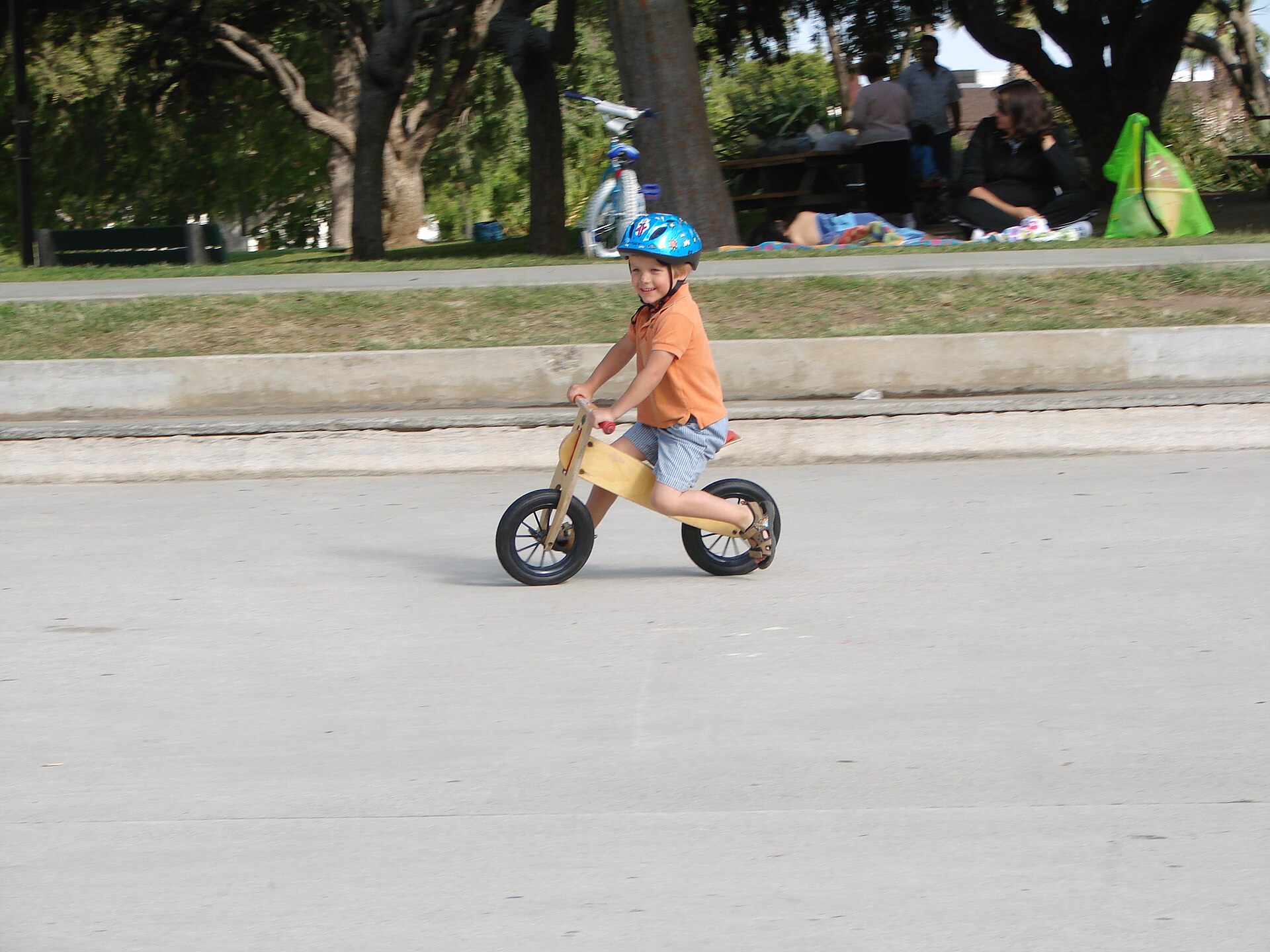
For most four-year-olds, the right bike is the one that fits and matches their skill. A child who has never ridden is best served by a balance bike, or a pedal bike with the pedals removed. A child who already balances can go straight to a small pedal bike. Fit matters more than any feature.
Balance bike or pedal bike: which one is right for your child?
Start with one question. Can your child already glide on two wheels?
If the answer is no, begin with balance. A balance bike has no pedals. Your child sits, pushes with both feet, and learns to steer and stay upright. Nothing else competes for their attention.
If the answer is yes, a pedal bike makes sense. Your child already knows how to stay upright. Now they only have to add pedaling.
There is a middle path. Many kids’ bikes allow you to remove the pedals and ride them as balance bikes. Put the pedals back on once your child glides with confidence. This is a good option if you want one bike for the whole trip and beyond.
Training wheels are the third route. They work, but they teach pedaling and not balance. Many kids’ bikes let you take them off when your child is ready to ride without them.
Here is how the three options compare:
- Balance bike: best for a child who has never ridden or still wobbles.
- Pedal bike with pedals removed: best if you want a single bike that grows with your child.
- Pedal bike with training wheels: best for a child who is eager to pedal and does not mind a slower path to balance.
- Pedal bike without training wheels: best for a child who already balances well.
Be honest about where your child is today. A bike that asks for too much too soon slows learning and can dent confidence.
What size bike fits a four-year-old?
Kids’ bikes are sized differently from adult bikes. Adult bikes are measured by frame size. Kids’ bikes are measured by wheel diameter. Sizes run from 12 inches up to 26 inches.
Product listings often show 12-inch bikes aimed at ages 3 to 4, and 16-inch bikes aimed at ages 4 to 7. Size brackets are wide and they overlap. Use them as a starting point and not as a verdict.
Measure your child first
Measure height, then measure inseam. Wheel size follows from height and age. Inseam tells you whether your child can hop on and off comfortably.
Do not size up in the hope that your child will grow into the bike. A bike that is too big can slow learning and hurt confidence. A bike that fits helps your child feel comfortable and build skills faster.
Check the fit with your eyes
You do not need a shop to check fit. Put your child on the bike on flat ground and look at four things.
- Seat height: on a balance bike, or on a first bike without training wheels, your child’s feet should rest flat on the ground while seated. With training wheels, or once they are comfortable on pedals, only the toes should touch.
- Knee bend: a beginner needs more bend in the knees so the feet reach the ground easily. As confidence grows, raise the seat for fuller leg extension when pedaling.
- Standover clearance: your child should stand over the bike with both feet down and an inch or two between them and the top tube.
- Pedal position: the ball of the foot should rest flat on the pedal.
Bikes of the same wheel size can fit differently. If you can, try a few with your child standing next to you. If you cannot, use the four checks above.
Brakes, weight and frame: what suits rough campground paths?
Campground roads are not a smooth bike path. Expect gravel, packed dirt, lawn and the odd root. Choose the bike with that in mind.
Tires and terrain
Bikes meant for all-around riding handle roads, light gravel paths and even shortcuts across the lawn. They usually come with tires that grip a variety of surfaces. That is the type to look for.
Watch the styling. Some kids’ bikes look rugged but are meant for pavement. True youth mountain bikes are built for off-road riding, with knobby tires and suspension forks. A four-year-old rarely needs one. Most young kids ride short distances, so a simple, hybrid-style bike with no unnecessary features does the job.
Frame and weight
A lighter bike is easier for a small child to handle. Look for a sturdy, lightweight frame. Aluminum is a common choice on kids’ bikes. Check the listed weight and compare it with what your child can lift, stand up and steer. If your child cannot pick up the bike after a fall, it may be too heavy.
Check it before you buy.
Brakes that make sense at this age
Start simple. A balance bike has no brakes, and your child stops by putting their feet down. A coaster brake engages when you pedal backwards. Both feel natural to a beginner, because the instinct is to put your feet down or pedal back.
Hand brakes come later. Once your child stops confidently with a foot or coaster brake and has stronger hands, a hand brake becomes a good upgrade. Some bikes include both so kids can get used to hand brakes early.
Gears
Skip them for now. Beginner bikes usually have a single gear, and that is the right choice. Your child needs to learn to balance and pedal before shifting.
One last point on style: girls’ and boys’ bikes are essentially the same. Only the colors and graphics tend to differ.
Helmet fit and a few safety rules for small riders
A helmet goes on every time your child rides, even for a lap around the campsite. Make it a habit from the first ride.
A good helmet fit is easy to check:
- Level on the head: the helmet should sit flat, not tipped back or pushed forward.
- Snug, no wobble: when your child shakes their head, the helmet should stay put.
- Straps adjusted: the chin strap should be snug under the chin, not loose.
- Sized to the head: use the fit pads or dial that comes with the helmet and follow the maker’s sizing guidance.
Recheck the fit before each trip.
Make a few simple rules for the campground:
- Ride only on the roads or paths you have agreed on.
- Stay where you can see a parent, and where a parent can see you.
- Stop and put a foot down when a car or a camper moves nearby.
- Walk the bike through crowded areas and around other campsites.
- Park the bike off the road when you are done, never in the way of vehicles.
Read the signs at your site and in the office. Slow speeds near other sites are part of good camp manners.
Bright clothing helps drivers see small riders. Ride in daylight and bring the bike in before dusk.
Packing the bike and making early riding feel like play
A bike takes up real room in a loaded car. A small one is much easier, but you still need a plan.
Fit it in the car
- Pack it last or first: either put the bike in first and build around it, or load it last so you can pull it out without unpacking everything.
- Lay it on its side: place it with the chain side up, on a blanket or towel.
- Remove what you can: pedals on a convertible model and a loose seat make a bike easier to stow.
- Protect everything else: a bike chain leaves grease on coolers and bags. A towel or a plastic sheet keeps the mess off your gear.
- Tie it down: a loose bike can shift when you brake. Wedge it in with soft bags.
A balance bike is the easiest to pack, since it has no pedals and is usually light.
Keep it fun
Early riding works best when it feels like a game and not a lesson. Skip the instruction. Try some play instead:
- Slow race: the last rider to the finish line wins. It rewards balance and control.
- Follow the leader: you walk a path, your child rides behind and copies your turns.
- Cone course: set out cups, shoes or small sticks and weave between them.
- Mail carrier: your child delivers letters or small objects to neighboring tents or chairs on your own site.
- Stop and go: call out a color or animal, and your child rides to something that matches.
Pick a flat, open spot away from traffic. A cleared patch of ground near your site works well. Keep each session short. When your child loses interest, stop. They will want the bike again after a snack and a rest.
Praise effort. Wobbles and falls are part of learning. A calm tone from you matters more than any piece of gear.
Related reading
- Backyard Camping as a Dress Rehearsal: Test the Tent, the Kids and the Plan Before You Drive Anywhere
- Camping With Your Dog: Leashes, Heat, Water and How to Share a Tent With a Wet Animal
Sources
- Kids Bike Buyer’s Guide by Age & Size (electra.trekbikes.com, accessed 2026-11-23)
- Lightweight Kids Bikes (bestbuy.ca, accessed 2026-11-23)
Photo: Showing a balance bike does not include pedals, by Jeremy Miles, CC BY-SA 2.0 (Wikimedia Commons)